


|
Getting the keys to your Guam rental is exciting. You want to move in, unpack, and start making the place feel like home. But before the furniture and boxes come in, take some time to document the condition of the property. Your move-in inspection creates a record of what the home looked like when you received it. That record can become very important when you eventually move out. “ The best time to protect your security deposit is the day you receive the keys—not the day you move out.”If you are still looking for a home, our Renting on Guam guide explains the rental process and what to expect before signing a lease.
|
Table of Contents |
Why Does Your Move-In Inspection Matter?
A move-in inspection is not about trying to find something wrong with the property.
It is about establishing the starting condition of the home.
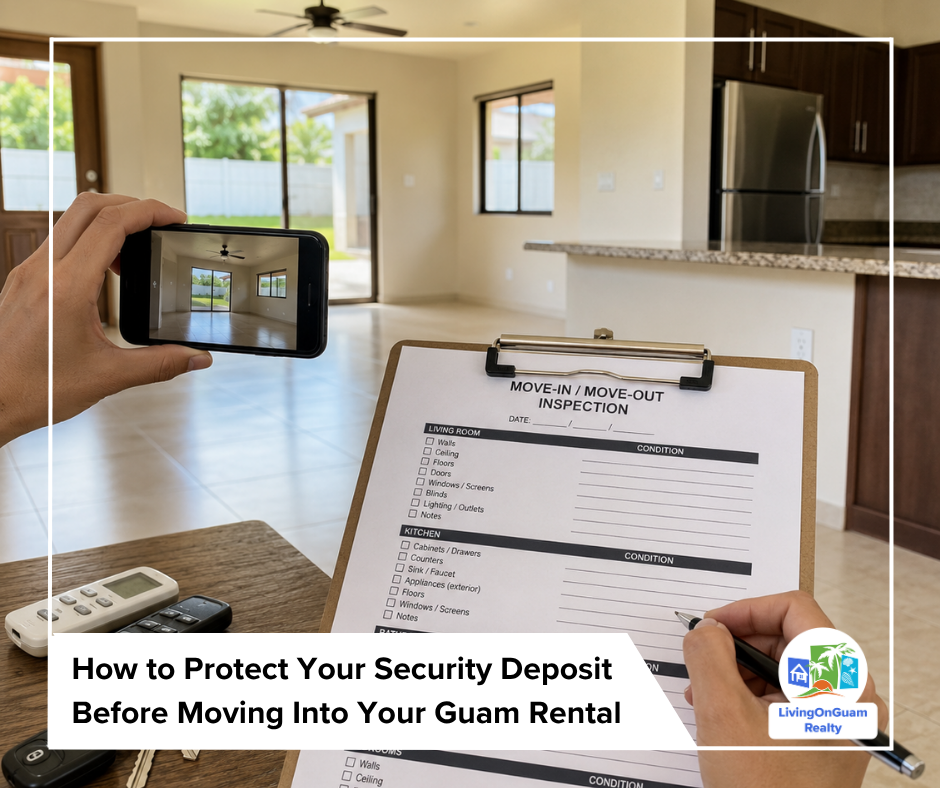
Realtors on Guam commonly use a move-in/move-out inspection form (MIMO) to document the property’s condition in writing.
Save your copy.
That form can later be compared with the condition of the home when you move out.
But writing only tells part of the story.
A note that says “scratch on wall” does not show how large the scratch was, exactly where it was, or what it looked like.
That is why photos and video are so important.
“ The inspection form gives you the written record. Photos and video show what the property actually looked like.”
Maybe there is:
-
A scratch on a bedroom door
-
A chipped floor tile
-
A stain near an AC unit
-
A torn window screen
-
A broken blind slat
-
Rust on an exterior fixture
-
A dent in an appliance
-
A mark on a countertop
These things may seem minor when you move in.
Months later, nobody may remember whether they were already there.
“ If you see it when you move in, document it—even if it seems minor. ”
When Should You Do the Inspection?
Ideally, do it before your belongings are moved inside.
Once boxes and furniture are everywhere, it becomes harder to clearly see the walls, floors, cabinets, and other areas.
Walk through the property slowly and use all three:
-
The move-in/move-out inspection form
-
Date-stamped photos
-
A video walkthrough
We use a date stamp app when documenting property condition because it gives another clear reference showing when the photo was taken.
Take wide photos of each room, then close-ups of anything damaged or unusual.
And do not only photograph problems.
Take photos of areas that are in good condition too.
“ Your move-in photos should show the whole property, not just the things that are damaged.”
If you are working with an agent to find a Guam rental, you may also want to read our explanation of the Tenant Representation Agreement on Guam before you begin showings.
What Should You Photograph?
Think room by room.
Walls, Ceilings, and Floors
Look for:
-
Scratches
-
Nail holes
-
Cracks
-
Patches
-
Stains
-
Water marks
-
Chipped tile
-
Damaged flooring
Take a wide photo so you can see where the issue is, then a close-up if needed.
Windows, Doors, Screens, and Blinds
Check:
-
Torn screens
-
Bent screen frames
-
Broken locks
-
Damaged doors
-
Missing or broken blind slats
-
Windows that do not open or close properly
Screens and blinds are easy to overlook, but they are exactly the kind of thing that can become a question later.
Kitchen
Photograph:
-
Cabinets and drawers
-
Countertops
-
Sink area
-
Appliance exteriors
-
Existing scratches, dents, rust, or stains
-
Cracked shelves or broken handles
-
Any missing parts
The point is not to test every appliance as part of your security deposit documentation.
It is to record the condition they were in when you moved in.
Bathrooms
Check:
-
Sinks
-
Showers and tubs
-
Mirrors
-
Cabinets
-
Tile
-
Grout
-
Caulking
Existing stains, chips, cracks, or discoloration
Previous Post
Why Guam Tenants Must Sign a Tenant Representation Agreement Before Viewing Rentals
What About AC Units and Appliances?
Your move-in inspection is mainly about condition, not trying to predict what might break later.
For AC units and landlord-provided appliances, photograph any existing physical damage.
For example:
-
Dents
-
Scratches
-
Rust
-
Cracked shelves
-
Broken handles
-
Missing parts
-
Damaged remotes
- Existing stains or water marks around AC units
If an appliance later stops working during the lease, that should be reported to the landlord or property manager as a maintenance issue.
“ Your move-in inspection is about documenting condition—not predicting what might break later.”
What About the Yard and Exterior?
If you are renting a house, your inspection should not stop at the front door.
Walk around the property and photograph:
-
Yard condition
-
Fencing
-
Gates
-
Driveway
-
Carport or garage
-
Exterior walls
-
Outdoor fixtures
-
Landscaping
-
Existing exterior damage
If there is already a damaged fence panel, dead patch of grass, rust, or exterior staining, your move-in photos should show it.
“ For a house rental, your move-in record should include the outside of the property too.”
Should You Document Keys and Remotes?
Yes.
Lay out everything you received and take one clear photo.
That may include:
-
House keys
-
Mailbox keys
-
Garage remotes
-
Gate remotes
-
AC remotes
This gives you a simple record of what was turned over to you.
When it is time to move out, you can check the photo and make sure everything is returned.
Why Does This Matter Later?
Here is a simple example.
A renter moves into a Guam home and notices two damaged blind slats and a stain below an AC unit.
Both are written on the move-in inspection form, but no photos are taken.
A year later, the renter is moving out and there is a question about how bad the damage originally was.
The form helps because it shows the condition existed.
But a few date-stamped photos would have made the answer much clearer.
That is why the strongest move-in record includes both the written inspection form and visual documentation.
“ Good documentation removes the need to rely on anyone’s memory.”

Related Post
The Complete Guide To Moving To Guam
Where Should You Save Everything?
Do not leave hundreds of move-in photos buried in your camera roll.
Create a folder specifically for the property.
For example:
Guam Rental – Move-In – August 2026
Save:
-
Your move-in/move-out inspection form (MIMO)
-
Photos
-
Videos
-
Emails or messages reporting existing issues
-
Repair requests
Keep everything until after you move out and your security deposit has been settled.
Do not throw away or lose the inspection form just because the move-in is finished.
You may need it when it is time to compare the move-in and move-out condition.
What Should You Do Before Moving Out?
Pull up your original move-in inspection form (MIMO), photos, and videos.
Walk through the property again and compare the condition.
That can help you identify:
-
Cleaning that still needs to be done
-
Missing keys or remotes
-
Damage that happened during your tenancy
-
Conditions that were already there when you moved in
Your move-in documentation becomes your reference point.
“ Move-in documentation gives you a starting point. Move-out is when that record becomes valuable.”
Frequently Asked Questions
-
Do I need photos if I already completed a move-in/move-out inspection form (MIMO)?
Yes.
The form is important because it gives you a written record of the property’s condition.
But photos and video show exactly what the condition looked like.
The strongest documentation includes both.
-
Is a video walkthrough enough?
Video is helpful, but photos make it easier to document specific areas.
Ideally, use the inspection form, photos, and video together.
-
What if I notice something after I already moved in?
Document it as soon as you notice it and report it according to the procedures in your lease.
Do not wait until move-out.
-
How long should I keep my move-in documentation?
Keep the inspection form, photos, videos, and related communication until your move-out is complete and your security deposit has been settled.
3 Key Takeaways
-
Save your move-in/move-out inspection form (MIMO).
It is your written record of the property’s condition when you moved in.
-
Back up the written form with photos and video.
Words help, but pictures show exactly what the condition looked like.
-
Keep everything until the tenancy is completely finished.
Your inspection form, photos, videos, and written communication may become important when you move out.
“ Your inspection form tells the story in writing. Your photos and videos show what that story looked like.”
If you are still searching for the right home, start with our Renting on Guam guide.
And if you want help finding a Guam rental and understanding the process from the beginning, Living On Guam Realty can help you narrow down your options and find a home that fits what you actually need.
Leah del Mundo — Guam’s First AI Certified Agent, Guam’s Exclusive 72Sold Certified Agent
