|
You’ve probably seen listings that advertise a 2.25% or 2.75% VA assumable loan and wondered if it’s really as good as it sounds. The short answer? Sometimes. A VA assumable loan can save you hundreds of dollars each month compared to getting a new mortgage at today’s interest rates. But that doesn’t automatically mean it’s the best choice for every buyer. The biggest surprise for many buyers isn’t qualifying for the loan. It’s figuring out how to pay for the seller’s equity. Understanding that one piece can help you decide whether a VA assumable loan is a great opportunity—or whether a traditional VA loan makes more sense. “ A low interest rate is only part of the equation. The real question is whether you can comfortably afford the seller’s equity.” |
Table of Contents |
What Is a VA Assumable Loan?
A VA assumable loan allows a qualified buyer to take over an existing VA mortgage instead of applying for a brand-new loan.
Instead of borrowing money at today’s interest rate, you assume the seller’s remaining mortgage balance, interest rate, and repayment terms, subject to lender and VA approval.
For example:
A seller purchased a home a few years ago when interest rates were much lower.
Today, they still owe $425,000 on a VA loan with a 2.50% interest rate.
Instead of getting a new mortgage at today’s rate, you may be able to assume that existing loan.
That can significantly reduce your monthly mortgage payment.
But there’s one important detail.
You’re only assuming what’s left on the loan—not buying the entire home for that amount.
Who Can Assume a VA Loan?
One of the biggest misconceptions about VA assumable loans is that only veterans can assume them.
That’s not always the case.
A buyer does not have to be VA-eligible to assume every VA loan. If the loan servicer approves the buyer and all assumption requirements are met, a non-VA-eligible buyer may be able to assume the loan.
However, that doesn’t mean every assumption has the same impact.
If the buyer isn’t able to substitute their own VA entitlement, the seller’s entitlement generally remains tied to that loan until it is paid off or refinanced. Because of that, some sellers may prefer a buyer who is VA-eligible and can substitute their entitlement.
This is an important conversation for both the buyer and the seller before deciding whether a VA assumption is the right path.
“ Not every buyer has to be VA-eligible to assume a VA loan—but every buyer should understand how the assumption affects the seller’s VA entitlement.”
Why Are VA Assumable Loans So Popular Right Now?
When mortgage interest rates rise, older VA loans with lower interest rates become much more attractive.
A lower interest rate can mean:
-
Lower monthly mortgage payments
-
Less interest paid over the life of the loan
-
Greater purchasing power
-
More room in your monthly budget
For some buyers, those savings can make a meaningful difference over the years they own the home.
But the interest rate is only one part of the decision.
“ The lowest interest rate isn’t always the best deal. The best deal is the one you can comfortably afford.”

Previous Post
9 Things To Know About Guam VA Loans
The Part Most Buyers Don’t Expect: The Equity Gap
This is where many buyers become confused.
Let’s look at a simple example.
Home Asking Price: $500,000
Remaining VA Loan Balance: $425,000
The seller has built $75,000 in equity.
If you assume the seller’s VA loan, you’re only taking over the remaining $425,000 loan.
The remaining $75,000 doesn’t disappear.
It still has to be paid.
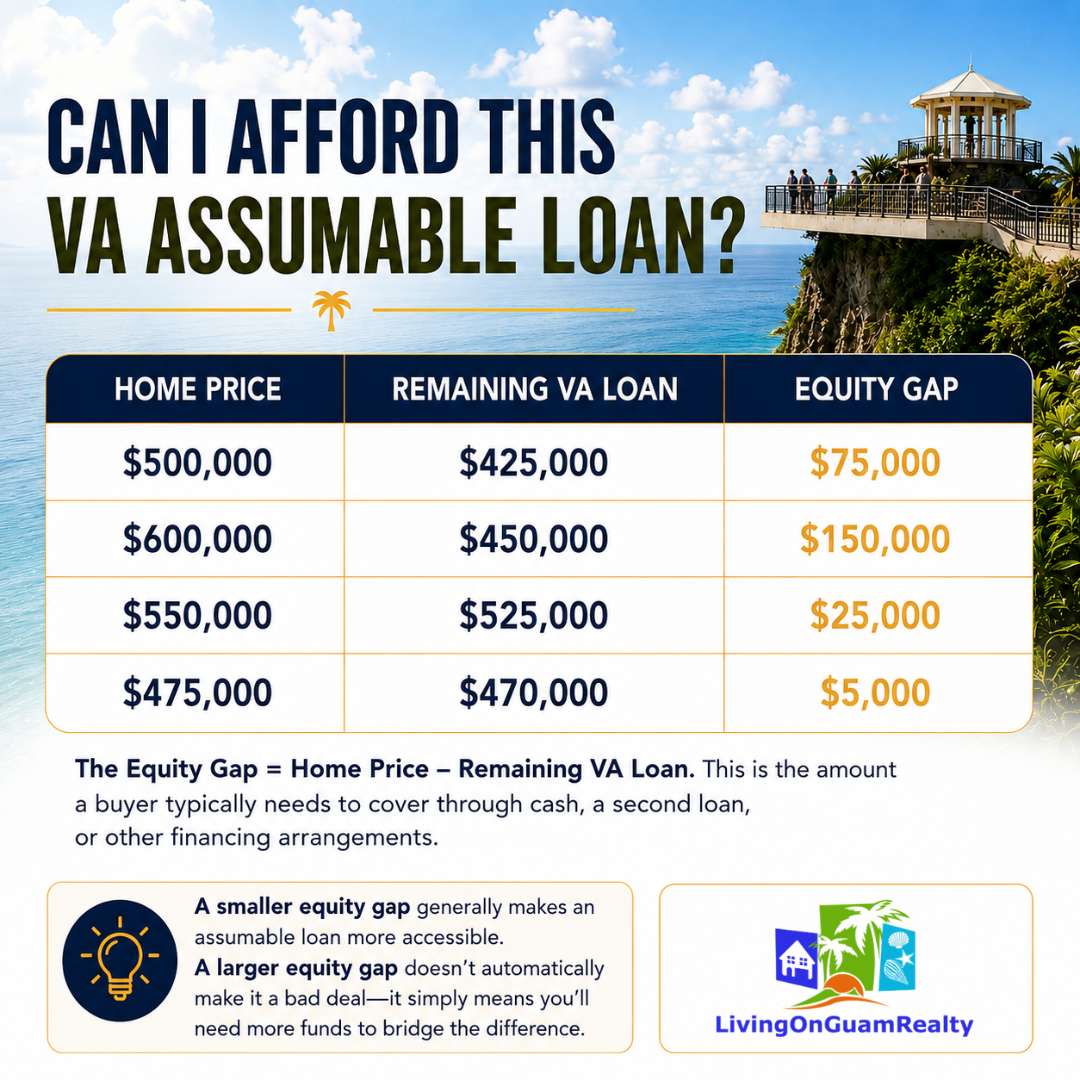
That’s called the equity gap.
Think of it this way.
The seller owns part of the home outright because they’ve been making mortgage payments and, in many cases, the home’s value has increased.
When you buy the home, you have to compensate the seller for that equity.
That’s why a VA assumable loan isn’t always as simple as taking over someone else’s mortgage.
How Do You Calculate the Equity Gap?
Fortunately, the math is simple.
Asking Price – Remaining VA Loan Balance = Equity Gap
Example:
-
Asking Price: $500,000
-
Remaining VA Loan Balance: $425,000
Equity Gap: $75,000
That’s the amount you’ll generally need to cover through cash, approved financing, or a combination of both.
Calculating this number early can help you determine whether an assumable VA loan is realistic for your budget.
“ The equity gap is one of the first numbers every buyer should calculate when considering a VA assumable loan.”
Should You Get Pre-Qualified Before Shopping for an Assumable VA Loan?
Absolutely.
In fact, I recommend getting pre-qualified for a traditional VA loan first.
Why?
Because it gives you a solid understanding of your buying power before you start looking for assumable loans.
If you later find a home with a great assumable interest rate, you’ll already know:
-
How much home you can comfortably afford.
-
Whether you have enough cash available to cover an equity gap.
-
Whether a traditional VA loan may actually be the better financial choice.
Think of a traditional VA loan as your backup plan.
If the right assumable loan doesn’t come along—or the equity gap is simply too large—you’ll already be prepared to move forward with another home.
“ Get pre-qualified first. Then decide whether an assumable VA loan truly works for your budget.”
Can You Use Secondary Financing to Cover the Equity Gap?
Sometimes.
In 2024, the VA clarified that approved secondary financing may be used in certain situations when assuming a VA loan. The guidance is available in VA Circular 26-24-17.
However, that doesn’t mean everyone will qualify.
The monthly payment on that second loan is included when the lender calculates your debt-to-income ratio.
In other words, borrowing more money may help cover the equity gap—but it also increases your monthly obligations.
That’s why every buyer’s situation is different.
Some buyers may qualify comfortably.
Others may decide that bringing cash to closing—or purchasing another home with a traditional VA loan—is the better financial decision.
When a VA Assumable Loan Made Sense
Let’s look at a real-life example similar to situations I’ve seen here on Guam.
A buyer found a home listed for $500,000.
The seller still owed $425,000 on a VA loan with a 2.50% interest rate.
That meant the equity gap was $75,000.
The buyer had been pre-qualified for a traditional VA loan before starting their Guam home search, so they already knew what they could comfortably afford.
They also had savings set aside for a down payment and closing costs.
After reviewing their finances with their lender, they decided they could comfortably cover the $75,000 equity gap without putting themselves in a financial bind.
For them, assuming the seller’s lower interest rate made sense.
Their monthly payment was significantly lower than it would have been with a new mortgage at current interest rates, and they planned to stay in the home for many years.
The upfront investment helped them save money over the long term.
“ A VA assumable loan works best when the equity gap fits comfortably within your overall financial plan.”
.png)
Related Post
Down Payment Help for Guam Home Buyers
When a Traditional VA Loan Was the Better Choice
Now let’s look at a different situation.
Another buyer found a beautiful home listed for $600,000.
The seller’s remaining VA loan balance was $450,000.
That created an equity gap of $150,000.
The buyer qualified for a traditional VA loan.
However, covering an additional $150,000 would have required using nearly all of their savings or taking on additional debt that would increase their monthly obligations.
Instead of stretching their finances, they decided to purchase another home using a traditional VA loan at current market rates.
If interest rates come down in the future, they can always explore refinancing.
For this buyer, protecting their financial flexibility was more important than locking in a lower interest rate.
There’s no one-size-fits-all answer.
The best financing option is the one that fits your financial goals—not simply the one with the lowest interest rate.
“ Sometimes the smartest financial decision isn’t assuming the loan. It’s choosing the option that lets you sleep well at night.”
How Do You Find VA Assumable Homes on Guam?
This is one area where Guam is different from many larger markets.
At the time of writing, our MLS doesn’t have a search filter that lets buyers look specifically for VA assumable loans.
That means finding these opportunities takes a little more work.
Some listing agents include the information in the property remarks.
Others don’t mention it at all.
A home may have an assumable VA loan without the listing ever saying so.
That’s why it’s important to let your buyer’s agent know early that you’re interested in assumable loans.
They can ask questions that aren’t always answered in the listing.
“ Some of the best assumable loan opportunities on Guam never appear in the listing description.”
Questions Your Buyer’s Agent Should Ask
If you’re interested in assuming a VA loan, your agent should contact the listing agent and ask questions such as:
-
Is the current loan a VA loan?
-
Is the seller willing to allow a VA loan assumption?
-
Who is the current loan servicer or lender?
-
What is the remaining loan balance?
-
What is the current interest rate?
-
What is the monthly principal and interest payment?
-
What is the asking price?
-
Has the seller already contacted the loan servicer about the assumption process?
-
Are there any known issues that could affect the assumption?
These questions help determine whether it’s worth pursuing before you spend time and money moving forward.
Why Getting Pre-Qualified First Makes the Process Easier
I always recommend getting pre-qualified for a traditional VA loan before shopping for assumable loans.
Here’s why.
When you know what you qualify for, you already have a benchmark.
Then, if you find a home with an assumable loan, you can compare both options.
You can ask:
-
Does assuming this loan lower my monthly payment enough to justify the equity gap?
-
Can I comfortably cover the equity gap without hurting my financial security?
-
If I need secondary financing, will I still qualify based on my debt-to-income ratio?
-
Would a traditional VA loan actually be the better fit?
Having both options available gives you flexibility.
Instead of chasing every assumable loan, you can focus on the ones that truly make financial sense.
A Simple Checklist Before Pursuing a VA Assumable Loan
Ask yourself these questions:
✓ Have I been pre-qualified for a traditional VA loan?
✓ Do I understand how much cash I can comfortably bring to closing?
✓ Have I calculated the equity gap?
✓ If I need secondary financing, have I discussed it with my lender?
✓ Will I still have an emergency savings fund after closing?
✓ Does the monthly savings justify the upfront investment?
If you can’t answer “yes” to most of these questions, it may be worth slowing down and talking with your lender before moving forward.
“ The goal isn’t just to buy the home. The goal is to buy it in a way that supports your long-term financial health.”
Common Misconceptions About VA Assumable Loans
Here are a few myths I hear from buyers.
Myth #1: Anyone can automatically assume a VA loan.
Not necessarily. The buyer still has to qualify, and the lender or loan servicer must approve the assumption.
Myth #2: You only need to qualify for the remaining loan balance.
You also need a plan to cover the seller’s equity.
Myth #3: A lower interest rate always makes an assumable loan the better choice.
Not if covering the equity gap puts unnecessary strain on your finances.
Myth #4: Every home with a VA loan advertises that it’s assumable.
On Guam, that’s often not the case.
Sometimes your real estate agent has to ask.
Frequently Asked Questions
-
What is a VA assumable loan?
A VA assumable loan allows a qualified buyer to take over the seller’s existing VA mortgage, including the remaining loan balance, interest rate, and repayment terms, subject to approval by the loan servicer and meeting applicable VA requirements.
-
Do I have to be a veteran to assume a VA loan?
Not necessarily.
A buyer does not have to be VA-eligible to assume every VA loan. If the loan servicer approves the buyer and all assumption requirements are met, a non-VA-eligible buyer may be able to assume the loan.
However, there’s an important consideration for the seller. If the buyer cannot substitute their own VA entitlement, the seller’s VA entitlement generally remains tied to that loan until it is paid off or refinanced.
That’s why buyers and sellers should discuss this with their lender, loan servicer, and real estate agent before moving forward.
-
How do I know if I can afford a VA assumable loan?
Start by getting pre-qualified for a traditional VA loan.
Then calculate the equity gap by subtracting the remaining loan balance from the asking price.
Finally, talk with your lender about whether you can comfortably cover that gap with cash or approved financing while still maintaining a healthy financial cushion.
-
Can I finance the equity gap?
Sometimes.
In 2024, the U.S. Department of Veterans Affairs clarified that approved secondary financing may be used in certain situations.
However, that additional loan payment is included when your lender calculates your debt-to-income ratio, so not every buyer will qualify.
-
How do I find VA assumable homes on Guam?
Our MLS doesn’t currently offer a search filter for assumable VA loans.
Some listing agents mention it in the property description, while others don’t.
If you’re interested in this type of financing, let your buyer’s agent know early so they can ask the listing agent whether a home has an assumable VA loan and gather the information needed to evaluate it.
-
Does every VA loan qualify for assumption?
No.
Although many VA loans are assumable, every loan still has to go through the loan servicer’s approval process. Qualification requirements, timelines, and documentation can vary.
-
Is assuming a VA loan always the best financial choice?
Not necessarily.
A lower interest rate is attractive, but the overall decision should take into account the equity gap, your available cash, your monthly budget, your long-term plans, and whether another financing option may better fit your financial goals.
For additional consumer information about mortgage assumptions, the Consumer Financial Protection Bureau provides a helpful overview.
Final Thoughts
A VA assumable loan can be an excellent opportunity.
For the right buyer, it may provide a significantly lower interest rate and lower monthly mortgage payment than obtaining a new loan.
But don’t let the interest rate be the only factor driving your decision.
The real question is whether the entire purchase—including the seller’s equity—fits comfortably within your financial plan.
That’s why I encourage buyers to start with a traditional VA loan pre-qualification.
Know your budget.
Understand your options.
Then, if you find a home with an assumable VA loan, you’ll be in a much better position to decide whether it truly makes sense for you.
Every buyer’s situation is different, and sometimes the best financial decision isn’t the one with the lowest interest rate—it’s the one that supports your long-term goals.
“ A VA assumable loan can be a great opportunity—but only if it fits both your budget today and your goals for tomorrow.”
3 Key Takeaways
1. Get pre-qualified for a traditional VA loan before shopping for assumable loans.
Knowing your buying power gives you a solid starting point and helps you compare all of your financing options.
2. Calculate the equity gap early.
The asking price minus the remaining VA loan balance tells you how much you’ll likely need to cover through cash or approved financing.
3. Don’t chase the interest rate—evaluate the entire financial picture.
The best loan isn’t always the one with the lowest rate. It’s the one that allows you to buy confidently without overextending your finances.
Ready to Explore VA Assumable Loans on Guam?
If you’re thinking about buying a home on Guam and want to know whether a VA assumable loan is right for you, I’d be happy to help.
We’ll review your goals, discuss your financing options, and help you compare assumable loans with traditional VA financing so you can make an informed decision.
Sometimes an assumable loan is the best choice.
Sometimes it isn’t.
The important thing is understanding the difference before you make an offer.
Living On Guam Realty — Moving You Forward with pricing decisions grounded in today’s market, not yesterday’s expectations.
Leah del Mundo — Guam’s First AI Certified Agent, Guam’s Exclusive 72Sold Certified Agent
