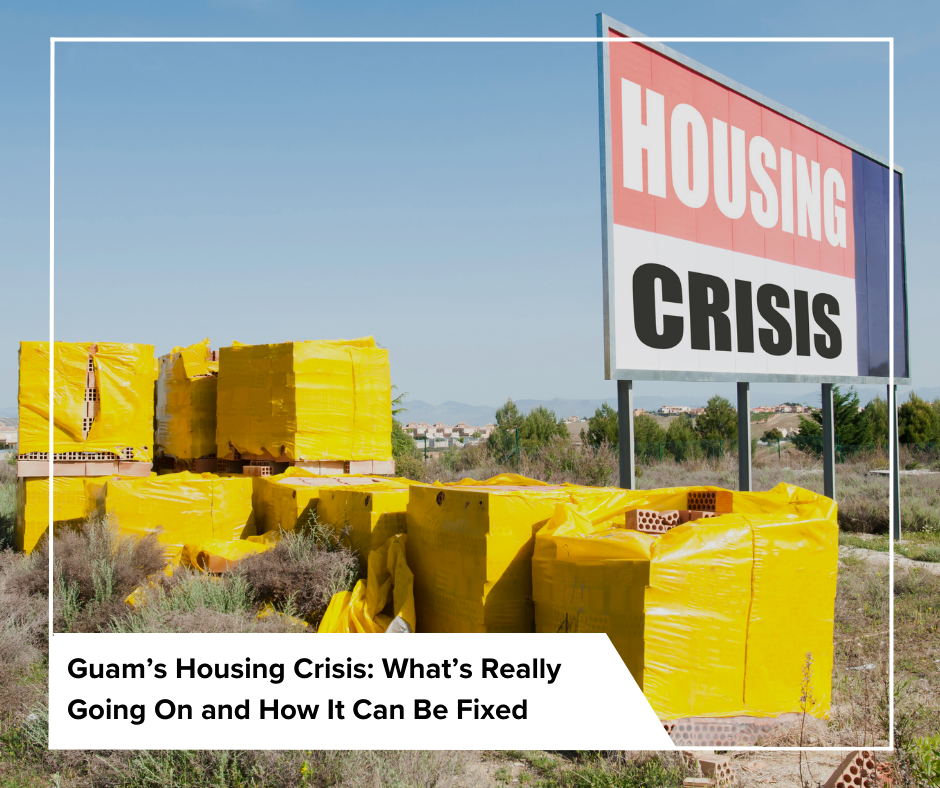
Guam’s housing crisis is a growing concern, affecting residents at every income level. Inventory is tight, prices are high, and trying to build a home comes with significant challenges. A recent discussion featuring Ryan Mummert, President of Pinpoint Guam Real Estate and General Manager at Title Guaranty of Guam and Tae Oh, Vice President of Vantage Advertising and PSI Holding LLC, former member of the Guam Land Use Commission, and Chairman of the Guam Chamber of Commerce, shed light on the core issues and potential solutions to this ongoing problem.
 Common Misconceptions About Guam’s Housing Crisis
Many assume that because Guam has plenty of land, housing should be affordable. However, much of the land is controlled by the U.S. military, designated for conservation, or not zoned for residential development. Even when land is available, infrastructure—such as roads, water, and sewer systems—must be in place, adding to the complexity and cost of development.
Another misconception is that developers are driving up housing costs due to greed. In reality, construction costs are exceptionally high. Guam’s building codes are strict due to typhoons and earthquakes, all materials must be imported, and labor shortages further drive up expenses. Additionally, the permitting process is lengthy, sometimes taking longer than the construction itself, discouraging large-scale developments.
Key Barriers to Housing Development
- Restrictive Zoning & Building Codes
- While strong building codes ensure safety, they also increase construction costs, making homeownership less attainable. - Lack of Infrastructure
- Without sewer lines and proper utilities, land use is restricted, limiting higher-density developments that could increase affordability. - High Construction Costs
- Materials and labor are expensive, and strict regulations require homes to be built with reinforced concrete rather than less costly materials like wood. - Permitting Delays
- The approval process can take six to eight months, which is often longer than the actual build time, adding significant costs and uncertainty for developers. - Market Challenges
- If prices drop too much, developers won’t build. If prices remain high, locals are priced out. Finding the right balance is crucial.
Potential Solutions to Address the Crisis
Several models worldwide have successfully tackled housing shortages. Singapore, for instance, has developed high-quality, mixed-use housing where market-rate and affordable units coexist, ensuring infrastructure is in place before development begins. Similar strategies could be applied in Guam.
.png)
- Public-Private Partnerships (PPP)
- Tax incentives and density bonuses could encourage developers to build affordable housing.
- Government support for infrastructure development would help lower costs for builders. - Streamlining Permitting for Affordable Housing
- Developers that allocate a percentage of units to affordable housing could receive priority in the permitting process.
- Pre-approved home designs could reduce processing time. - Adjusting Lot Size Requirements
- If infrastructure is available, smaller lots should be allowed to increase housing density and availability. - Exploring Alternative Construction Methods
- 3D-printed homes offer potential cost savings.
- Insulated Concrete Forms (ICF) could be a viable, cost-effective building solution.
- Large-scale developments would benefit from economies of scale, reducing per-unit costs. - Expanding Accessory Dwelling Units (ADUs)
- Homeowners should be encouraged to build small rental units on their properties, which would increase available housing and provide additional income streams. - Improving Financing Options
- Programs like the USDA Direct Loan, which offers below-market interest rates, should be more widely promoted.
- Multi-family homeownership (such as purchasing a fourplex and renting out units) could provide an alternative pathway to wealth-building. - Investing in Walkable, Mixed-Use Communities
- Future housing developments should integrate residential, retail, and commercial spaces, reducing reliance on cars and making neighborhoods more accessible.
What’s Next for Guam’s Housing Market?
With the military buildup extended to 2032, demand for housing will continue to rise. Prices are expected to increase, but not at the rapid pace seen in recent years. Government action is necessary to create clear policies that enable developers to build efficiently and affordably.
.png)
The key takeaways:
- Housing prices are unlikely to drop significantly without policy intervention.
- Infrastructure investment is essential for sustainable development.
- Developers need incentives to take on new projects without excessive risk.
Guam’s housing market will not fix itself. Proactive solutions must be implemented to make homeownership more attainable for residents.
For those interested in learning more about this discussion, the full conversation with Ryan Mummert and Tae Oh can be found in the referenced video. CLICK HERE.
--
Warmest regards,
Leah del Mundo
Guam’s Exclusive 72Sold Certified Agent
Guam’s First AI Certified Agent
